

Launched: Fall 2021
Decommissioned: Spring 2022
Icarus 2.0 delivery is a modified Icarus, to felicitate the transport of a marker to tag the goals to make the detection of the goal easier.
Launched: Fall 2019
Decommissioned: Fall 2020
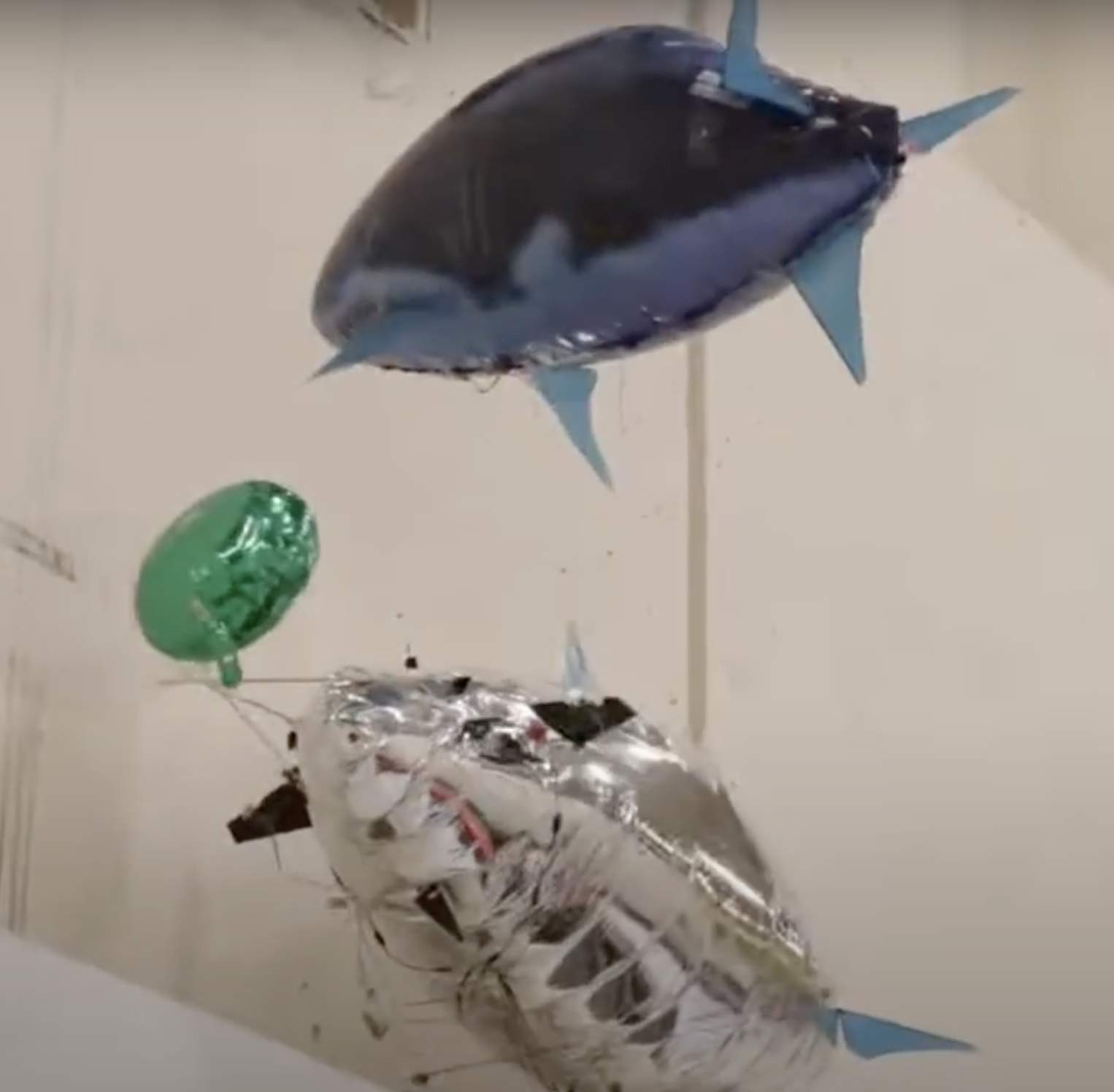
Netty is a spin-off of Speedy, but essentially can be a spin-off of any kind of blimp. He has the same actuation mechanism as speedy the shark. He has a smaller 1000 mah battery and can run for an hour.
He has an ESP 32 for his brains and the communication happens using Xbee. For this blimp, we have designed the PCB in house. He has a number of fins on the body to help maintain his
linear stability. The net suspended below the blimp is very effective to block the attacking agents. He is the main defensive blimp of our team during 99++ LuftBalloons Nov 20'

Launched: Fall 2019
Decommissioned: Fall 2020
Speedy is one of the most efficient blimps in terms of performance. He features a unique mechanism to provide thrust and yaw control,
called the ‘Azimuth Propeller’. With just one propeller trying to push the blimp, because of its aerodynamic shape, he is still fast. Unlike the Soccer Ball Blimp,
he has a smaller 1000 mah battery and can run for an hour. He has an ESP 32 for his brains and the communication happens using Xbee. For this blimp, we have designed the PCB in house.
He has a number of fins on the body to help maintain his linear stability. He was the first blimp to score a goal in a one on one blimp soccer game. Specialty- Fast,
Less number propellers, Most stable, Goal Scorer (Striker), Primary Agent in 99++ LuftBalloons Nov 20'.

Launched: Fall 2019
Decommissioned: Fall 2020
This was one of the first in-house designed blimps for the project. It had 4 propellers in total, two on the bottom to provide vertical motion and two propellers on either side of the blimp to provide forward motion. This design is geometrically symmetric with uniform weight distribution and hence very stable. Hulk uses an Arduino Nano as the main microcontroller. With 140 gms of payload, it facilitated a huge 2500 mah battery, which gave it a runtime of over an hour and a half. It had an ultrasonic sensor on the bottom which measured the distance from the ground and ran PID feedback control to get the capability of autonomous altitude control.

Launched: Fall 2019
Decommissioned: Fall 2020
This concept for the Plimp was derived from using plane control surfaces that were serviceable to a blimp. The Plimp’s strength has been speed. With a large propeller moving the LTA agent and large control surfaces, it has been very quick in linear motion yet is capable of a decent turn radius. While the two wings control the altitude control. The Plimp utilizes an Adafruit Feather M0 as the micro-controller.

Launched: Fall 2019
Decommissioned: Fall 2020
Wayne The Fish is a fish-like blimp (as the name goes). For motion, it uses a servo-powered fin at the tail to propel it forwards and change the direction of the nose (Yaw angle). Additionally, it has a movable mass that allows the blimp to pitch up or down. Combining these motions, it is able to traverse the 3-D space. Finally, There are 3 passive fins that direct the blimp's path in a straight line while flapping. We have developed a bespoke control board for the blimp that allows the blimp to know its current orientation. It has a 500mAH 1S battery and has the longest run time of 3 hours.

Launched: Fall 2019
Decommissioned: Fall 2020
Bruce is a blimp built to mimic the natural design of a shark. Sporting two forward motors and a rear tail-fin, Bruce specializes in speed and accuracy. The two forward motors supply the speed. The rear tailfin allows for accurate horizontal movement. A vertical motor provides altitude control. Built off the Blimpduino kit; Bruce has built-in altitude control and yaw management.